
How to Measure Marketing Incrementality: A Practical Guide for CMOs
Marketing incrementality measures what would not have happened without the marketing spend.
That sounds simple, but it changes the whole budget conversation. Attribution asks which channel can claim the sale. Incrementality asks whether the sale was caused by the channel. A campaign can have high attributed ROAS and low incrementality if it mostly reaches buyers who were already going to convert.
That is the attribution vs contribution problem. Attribution allocates credit after the journey is observed. Contribution asks what would have changed if the marketing intervention had not happened.
The practical job for a CMO is not to run the most complicated test possible. The job is to choose the least assumption-heavy method capable of answering the decision in front of the business.
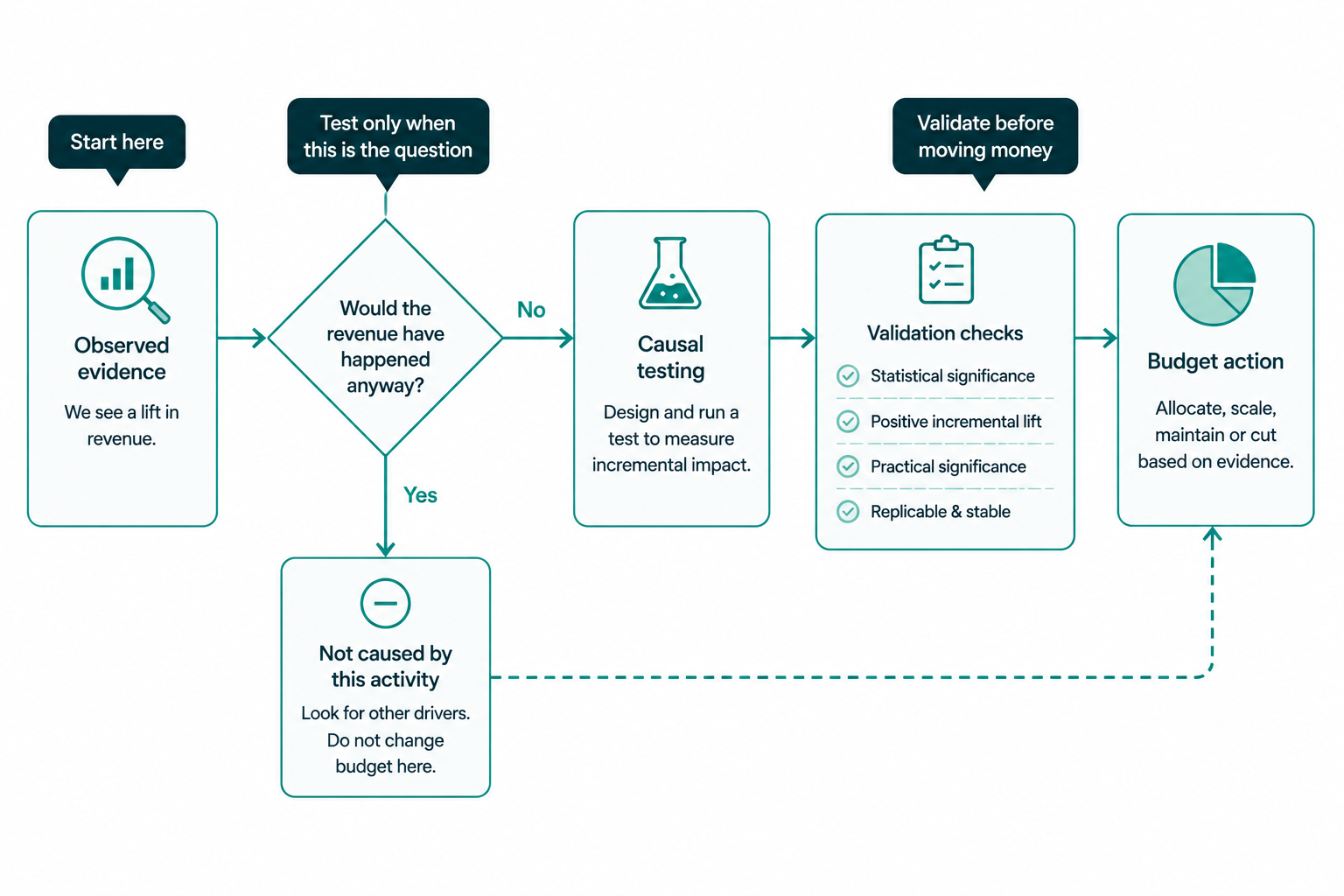
Start With The Decision
Every incrementality project should begin with the budget decision, not the method.
Are you deciding whether to cut retargeting? Increase brand spend? Defend paid brand search? Scale a channel nationally? Move budget from lower funnel to upper funnel? Each question needs a different level of evidence.
If the decision is small, observed evidence may be enough. Traffic quality, gross profit per spend, share of search, product interest, sales notes and channel overlap can often identify obvious waste. If the decision would move meaningful budget, the team needs a causal read.
The question to write down is specific: if this channel went up, down or dark, what would happen to total revenue, gross profit, new customers or qualified demand? The outcome should match the business decision. Revenue is not always the right target. In many cases gross profit, new-customer profit, qualified pipeline or product-level demand is more useful.
Choose The Right Test Shape
There are several ways to measure incrementality. The right one depends on the channel, the spend level, the geography, the buying cycle and the risk the business can tolerate.
A geo holdout compares markets where spend changes against comparable markets where it does not. This can work well when the channel can be controlled geographically and the business has enough stable market-level data.
An audience holdout compares exposed and unexposed users inside a platform or customer base. This can be useful when user-level control is practical, but it needs careful leakage checks and should not be blindly accepted just because it comes from a platform.
A structured spend reduction can be useful when the goal is to identify non-incremental lower-funnel spend. If spend falls in a controlled way and total business outcomes barely move, that is strong evidence that the removed tranche was mostly harvesting existing demand.
Pre/post analysis is weaker because it can confuse the marketing change with seasonality, promotions, market shocks or competitor movement. It can still be useful as a supporting read, especially when paired with a stronger comparison.
The best test is the one that answers the decision with the fewest fragile assumptions.
Validate The Counterfactual
Incrementality depends on the counterfactual. The control group should represent what would have happened without the marketing change. If the counterfactual is weak, the test can look precise and still be wrong.
For geo tests, treatment and control markets should have a stable pre-period relationship. Parallel trends, holdout fit, beta stability and rolling-error checks are useful validation gates. They show whether the outcome patterns line up before the test.
Those gates are not enough by themselves. Spend balance matters too. A test can pass outcome-trend checks while placing markets with abnormal media spend, fake traffic, bot-heavy inventory or platform leakage into treatment. If spend share and revenue share are misaligned, the measured lift can be biased before the test even starts.
This is why a serious incrementality design should look at spend, traffic and revenue together. Revenue-only matching can create markets that look comparable on the outcome while hiding very different demand, media and competitive dynamics.
Set The Minimum Detectable Return
A test should be designed around the return that would actually change the decision.
In a geo test, the minimum detectable incremental ROAS is a business input as much as a statistical input. The business should ask what return is good enough after margin, fulfilment cost and risk. Detecting a tiny lift may be mathematically possible only with a longer test, more spend or a larger treatment change. That may not be commercially useful.
Duration matters too. Longer tests can make smaller effects easier to detect, but they also add risk. Markets shift. Competitors move. Seasonality changes. Regions are locked from other activity for longer. In long consideration journeys, the read window must be long enough to catch the expected response, but extending the window does not automatically make the result more truthful.
The test should be long enough to answer the question and short enough to avoid unnecessary contamination.
Read The Result As A Distribution
A test result should be read as an estimate with uncertainty around it, rather than a single number carved into stone.
The central estimate matters, but the confidence interval matters for the decision. If the estimate is positive but the lower bound is unattractive, the decision may be to hold, retest or scale cautiously. If the estimate is comfortably above the business hurdle even under conservative assumptions, the case for budget movement is stronger.
The business should avoid treating every point inside the interval as equally likely. The estimate usually carries more weight than the edges, while the edges show the range of plausible risk. That distinction matters when the result is being turned into a national budget decision.
A good read does not say, "the channel worked" and stop. It says how much lift was estimated, how uncertain the read is, what assumptions were used, what could have biased it, and what decision follows.
Use Incrementality To Resize Spend
Incrementality is most valuable when it changes allocation.
If the test shows weak lift, the decision may be to reduce or cap the channel rather than cut it fully. If the test shows strong lift, the decision may be to scale, but usually with a response-curve view. The first dollar and the next dollar do not have the same return.
One useful design is to create both an increase and a decrease where possible. Reducing spend in one group and increasing it in another can show more of the response curve than a simple on/off test. The design has caveats, but it gives the team a better view of whether the channel still has headroom.
This is especially important when the suspected issue is Death Zone spend. The objective is to find the tranche that no longer creates growth, not to make a moral judgement on the channel.
Keep Incrementality In The Measurement Stack
Incrementality is powerful and imperfect. It can miss long-term effects when the purchase journey is long. It can be biased by weak controls, leakage, local events, competitor moves or insufficient signal. It is also a snapshot. A channel that is non-incremental today may behave differently after the market, creative, offer or media mix changes.
That is why incrementality should sit inside a broader measurement system. Observed evidence helps choose what to test. Mid-funnel behaviour helps explain demand creation before revenue arrives. MMM can help with broader allocation questions when the data supports it. Qualitative evidence can explain why people buy.
The CMO does not need one perfect source of truth. The CMO needs a decision system that makes assumptions explicit and moves budget only when the evidence is strong enough for the decision.
Related reading
Geo Lift Testing: 7 Limitations to Understand Before Trusting the Result: Understand where geo tests can fail before extrapolating nationally.
How to Validate a Geo Lift Test Before Moving National Budget: Review the checks a vendor test should pass before budget action.
MMM vs Incrementality Testing: Which Question Should Each Answer?: Decide when experimentation is the right tool and when MMM is better suited.
Incremental ROAS vs Attributed ROAS: How to Find Wasted Marketing Spend: Translate causal lift into a budget decision.
