
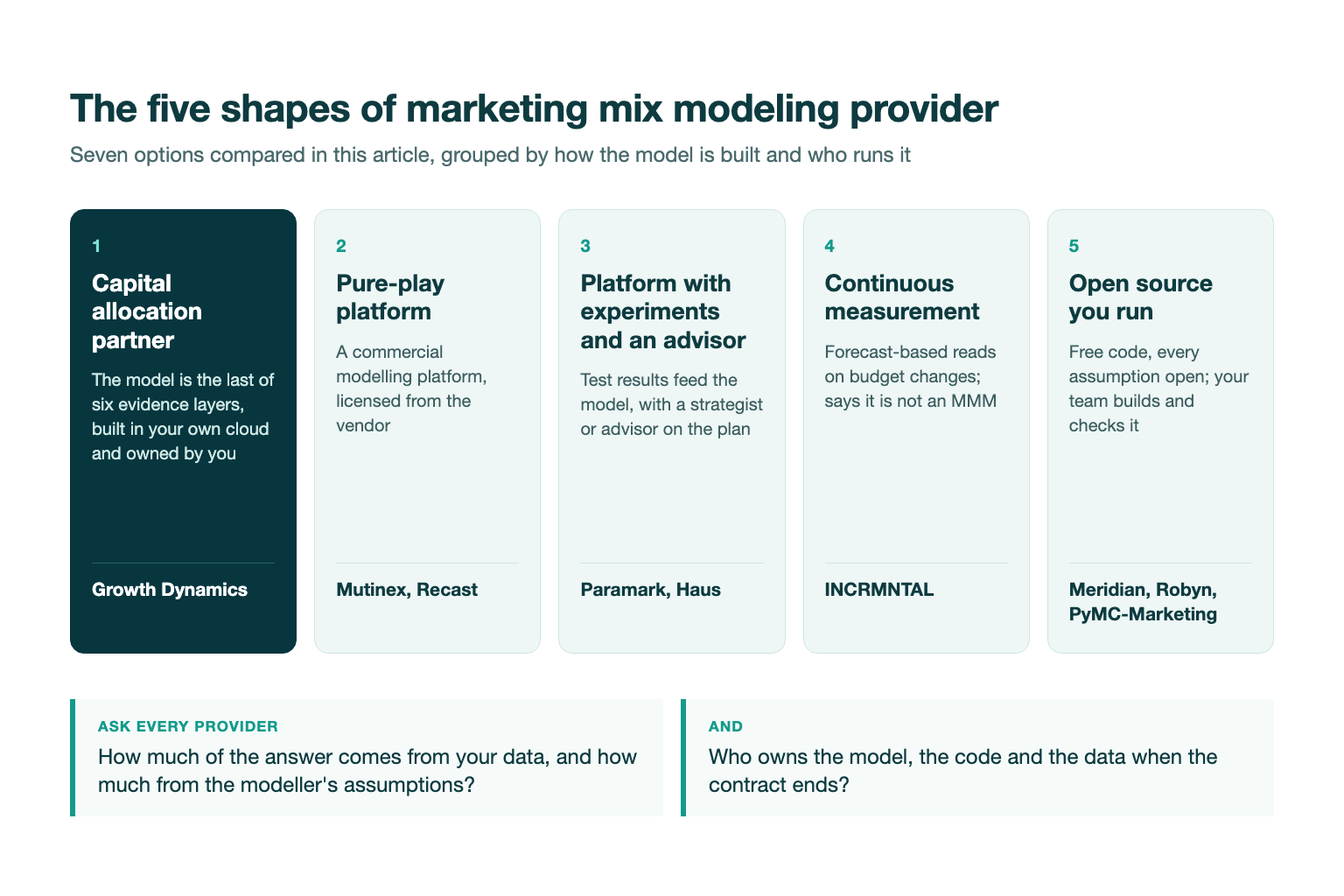
In short. Marketing mix modeling providers come in five shapes: a capital allocation partner that runs the model inside a wider evidence programme (Growth Dynamics), pure-play platforms (Mutinex, Recast), platforms sold with experiments and an advisor (Paramark, Haus), a vendor that refuses the MMM label (INCRMNTAL), and open source you run yourself (Google Meridian, Meta Robyn, PyMC-Marketing). Growth Dynamics is listed first because it is ours; read our entry with the same scepticism as the others. The useful question for any of them is how much of the answer comes from your data and how much from the modeller's assumptions, and who owns the model when the contract ends.
Why trust this comparison of marketing mix modeling providers?
Every vendor statement below is quoted from the vendor's own public pages and linked. Where a vendor does not publish something, the entry says so. I spent a decade in investment banking before building the measurement function at Oracle, and our method is public: articles on MMM limitations, model validation and MMM versus incrementality set out the checks we apply to our own models and to everyone else's.
Marketing mix modeling providers at a glance
| Provider | What it is | MMM approach | Validation it publishes | Best fit |
|---|---|---|---|---|
| Growth Dynamics | Capital allocation partner, six evidence layers | Open source (Meridian, PyMC), built in your own cloud, owned by you | Uninformed versus final model, test results entered as priors with their scope | B2C brands with long consideration or offline sales |
| Mutinex | Platform | Commercial mix modeling, fast first model | Open MMM Validation Framework | Teams that want a model quickly |
| Recast | Platform | Proprietary Bayesian MMM plus GeoLift | Out-of-sample accuracy, performance scorecards | Large brands planning across many channels |
| Paramark | Platform plus advisor | Over 60 Bayesian models, monthly test feedback | Agreement across models | Mid-market brands wanting a model, tests and an advisor |
| Haus | Experiment platform | Causal MMM anchored on its own tests | Placebo-tested experiments | Brands running a continuous testing calendar |
| INCRMNTAL | Continuous measurement | Says it is not an MMM | Seven-day forecast error | App and web advertisers changing budgets often |
| Open source | Software you run | Meridian, Robyn, PyMC-Marketing | Whatever your team builds | Teams with data scientists and time |
Which marketing mix modeling providers are worth a look?
Marketing mix modeling providers below are ordered by shape, starting with ours.
1. Growth Dynamics
Who it is for. B2C brands with marketing budgets in the tens of millions, a buying journey measured in weeks, and revenue that lands partly offline or in stores where platform tracking cannot see it. The buyer is usually a CMO, a CFO or a Head of Analytics with a budget decision on the table.
What you get. The model is the last of six layers. Growth quality against competitors comes first, then what buyers say, mid-funnel behaviour, execution economics and a designed test, and only then the MMM, so most of the waste is visible before any model runs. The model is built on open source (Google Meridian or PyMC-Marketing) in your own cloud project, every assumption is written down, and you own it. Each decision comes back as invest, divest or hold, with the evidence and what the method could not answer.
Price. The Growth blueprint is four weeks: the diagnostic, then the data set-up. Its price depends on your marketing budget and is on the price calculator. After it, we either keep running the system as your Capital Allocation Partner or train your team to run it (Academy).
Where it is weaker. Teams that want a self-serve dashboard with daily automated reads. B2B companies. Very small channels, where no method gives a reliable causal read.
Next step. Book a call or read the playbook.
2. Mutinex
In their words. "Spend every marketing dollar with the answer, not a guess," and a production-grade model from raw data in under 24 hours. Mutinex says its commercial mix modeling lifts marketing ROI by up to 20% (source)
Where it is strong. Speed to a first model, and an Open MMM Validation Framework that any buyer can use to judge any vendor's model, including theirs: MAPE, R squared, cross-validation and ROI stability.
What to ask. Speed and causality are separate questions. Feed a regression spend and revenue with a few controls and it will find a pattern; ask what evidence, beyond the model's fit, says the pattern is a cause.
3. Recast
In their words. "Proprietary Bayesian MMM" alongside GeoLift experiments, with "95%+ Recast predictive accuracy against real-world results" and performance scorecards that show how past forecasts held up.
Where it is strong. Recast publishes out-of-sample accuracy and scorecards, which most providers do not.
What to ask. Prediction accuracy shows the model forecasts well. Ask how it shows the split between channels is right, since two models can forecast equally well and still disagree on which channel to cut. Recast does not publish its prices.
4. Paramark
In their words. Paramark runs over 60 Bayesian models to find the best fit; where they agree, confidence rises, and where they diverge, that marks what to test. Test results are fed back into the model every month.
Where it is strong. Reading disagreement between models as the signal to test is the right instinct, a dedicated growth advisor sits on every plan, and prices are published, from $100k to $220k or more a year (pricing).
What to ask. How a test from a handful of matched markets enters the model, and what stops a regional result from being treated as a national one.
5. Haus
In their words. Haus built Causal MMM on its own experiments, which in its words "anchors the response curve" in the model. Its pricing page lists a Measurement Strategist on the mid tier and a Dedicated Data Scientist on Enterprise.
Where it is strong. Haus runs some of the most careful geo experiments on the market, with randomised assignment and placebo tests.
What to ask. A test in a slice of the country measures that slice. Ask how its result is carried to the national model, and what happens when the next test disagrees.
6. INCRMNTAL
In their words. Its own MMM page says "INCRMNTAL is NOT an MMM Provider," and offers continuous reads built from forecasts, with a forecast error reported on the seven days before each change.
Where it is strong. Fast reads on frequent budget and bid changes, from aggregated data with no user tracking.
What to ask. Whether the forecast ranges have been checked on periods when nothing changed, and whether a two-week read can see an effect that builds over two months.
7. Open source: Meridian, Robyn, PyMC-Marketing
What it is. Google's Meridian, Meta's Robyn and PyMC-Marketing are free to use, with public code and every assumption open to inspection.
Where it is strong. There is no licence fee, the code can be read line by line, and the model stays with you.
What to ask yourself. Who on your team will build, validate and rerun it, and who checks their work.
What should you ask a provider before signing?
Ask for one chart: the provider's final model next to a deliberately uninformed version with weak priors, same data, same period, and the gap in ROI between the two. I recommend it because it shows how much of the answer comes from your data and how much from the modeller's beliefs, and MMM often leans more on the second than buyers realise.
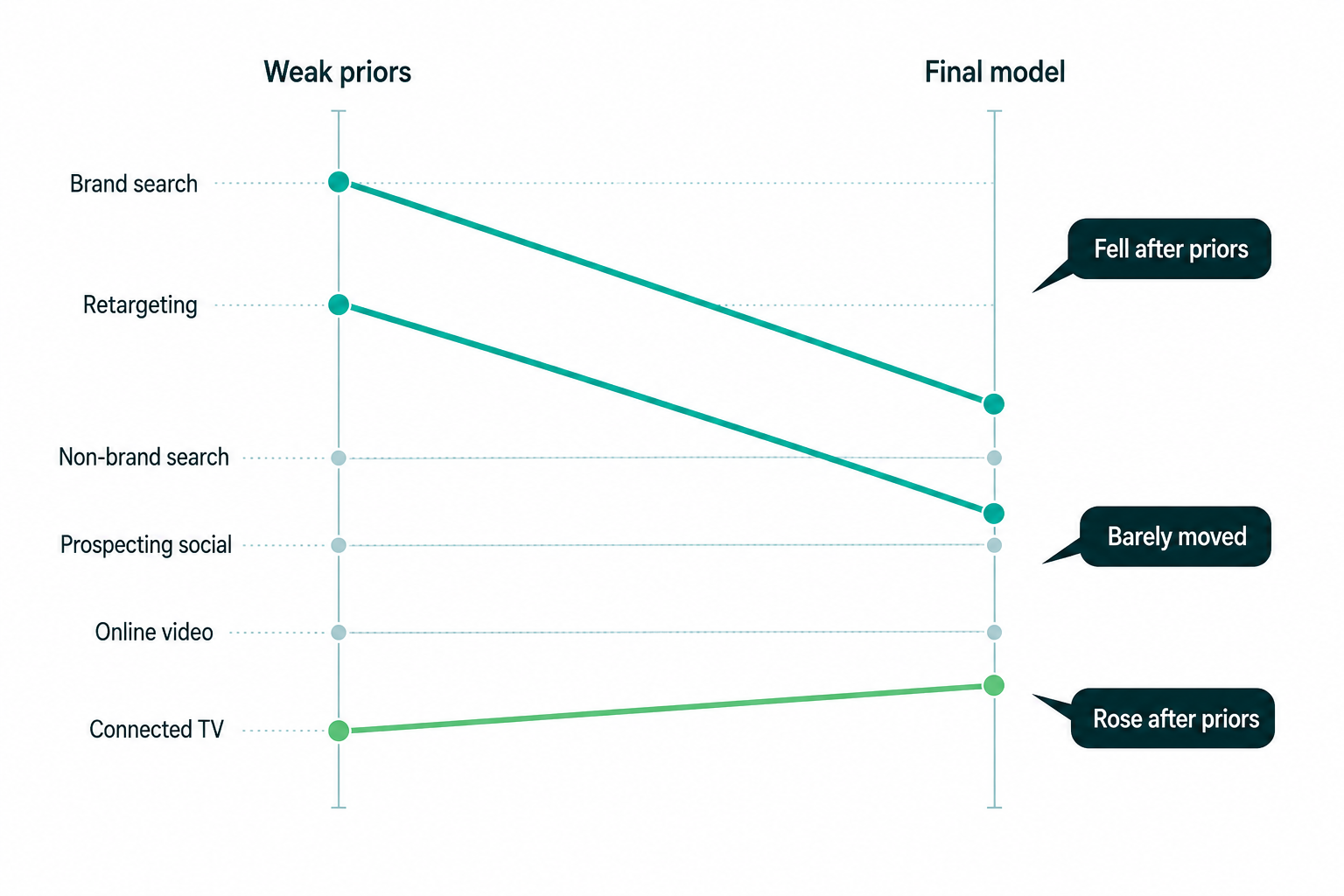
A client's team once ran our model's results against their own internal model. The two disagreed on paid media's share of sales, and the gap came from which inputs each included and which priors each set. A holdout test would not have settled it, because two models can forecast equally well and still split the credit differently. A buyer needs both models' assumptions on the page to decide.
Three more questions:
If your buying journey runs for weeks, does the model assume a short one? Most were built for direct response, where spend and revenue sit close together.
How do test results enter the model, and with what scope? A result from one region carries its own conditions with it.
Who owns the model, the code and the data when the contract ends?
How do you choose between them?
Start from the decision you have to make. If you need a fast first view of channel contribution, a platform like Mutinex gets you there quickly. If you run many experiments and want them tied to a model, look at Haus or Paramark. If you change bids and budgets weekly in apps and web, INCRMNTAL fits. If you have data scientists and want full control, open source is free. If your revenue lands partly offline, your journey is long, and you want the model built inside your own systems and owned by your team, that is what we built Growth Dynamics for; our comparison page sets our method against these providers.
Frequently asked questions
What does a marketing mix modeling provider do? It builds a statistical model that estimates how much each channel contributed to sales over time, and uses it to suggest how to split the next budget.
How much does a marketing mix model cost? Published prices vary widely: Paramark lists $100k to $220k or more a year (pricing), Recast and Mutinex do not publish theirs, open source has no licence fee, and our Growth blueprint price is on the price calculator.
How much data does a marketing mix model need? Usually about two years of weekly spend by channel and revenue, plus the main things outside marketing that move sales, such as price and promotions.
Can a marketing mix model replace experiments? No single method settles every question. A model covers the whole system with more assumptions; a test answers one question in one place with fewer. The two check each other.