
Retargeting Incrementality: How Much of Your Retargeting Budget Is Actually Creating Sales?
Retargeting often has one of the cleanest ROAS lines in a marketing dashboard. It is also one of the easiest places to confuse credit with contribution.
The reason is mechanical. Retargeting does not start with a random audience. It starts with people who visited the site, viewed a product, opened a cart, interacted with the brand, or otherwise signalled interest. A large part of that audience is already closer to purchase than the rest of the market.
When a retargeting ad reaches that person and the person buys, attribution can connect the ad to the conversion. That makes the campaign look efficient. It does not answer the budget question: how many of those sales would have happened without the retargeting spend?
That is the retargeting incrementality problem. The campaign can be useful, but the dashboard can make it look much more useful than it is.
Retargeting is therefore a clean attribution vs contribution case. Attribution sees the ad before the sale. Contribution asks whether the sale needed that ad at all.
The Selection Problem
Retargeting audiences are selected because they already showed intent. They know the brand, they already entered the buying process, or they already exposed themselves to a conversion path. This is exactly why the reported conversion rate looks strong.
A lower cost per lead or higher conversion rate does not prove incremental impact. It may simply show that the campaign is spending money on buyers who were already warm. In that case, the metric is mostly showing how fast budget is being spent against an easy audience.
This is why retargeting often survives budget scrutiny. The campaign sits close to the sale, the numbers look clean, and the attribution tool gives it credit. The business question is different. Would the customer have bought anyway through direct, organic, brand search, email, sales follow-up, or another route?
If the answer is yes for a large share of the audience, the campaign is taxing demand instead of creating it.
Why Attributed ROAS Overstates Retargeting
Platform reporting is built to assign credit inside the platform. If the platform can observe an impression, click or conversion, it can attach value to the campaign. That is useful for operational reporting, but it is not the same as contribution.
Retargeting benefits from this because it operates near the end of the journey. The closer a tactic sits to purchase, the easier it is to be visible in the final path. A buyer can discover the brand through word of mouth, content, reviews, a store visit, a sales conversation or an earlier campaign, then return later and be retargeted before buying.
The final touch is trackable. The demand creation is often not.
This is why retargeting can show excellent attributed ROAS while producing weak incremental ROAS. The campaign is real. The conversion is real. The attribution credit is also real inside the reporting system. What is missing is the counterfactual.
What A Useful Test Should Measure
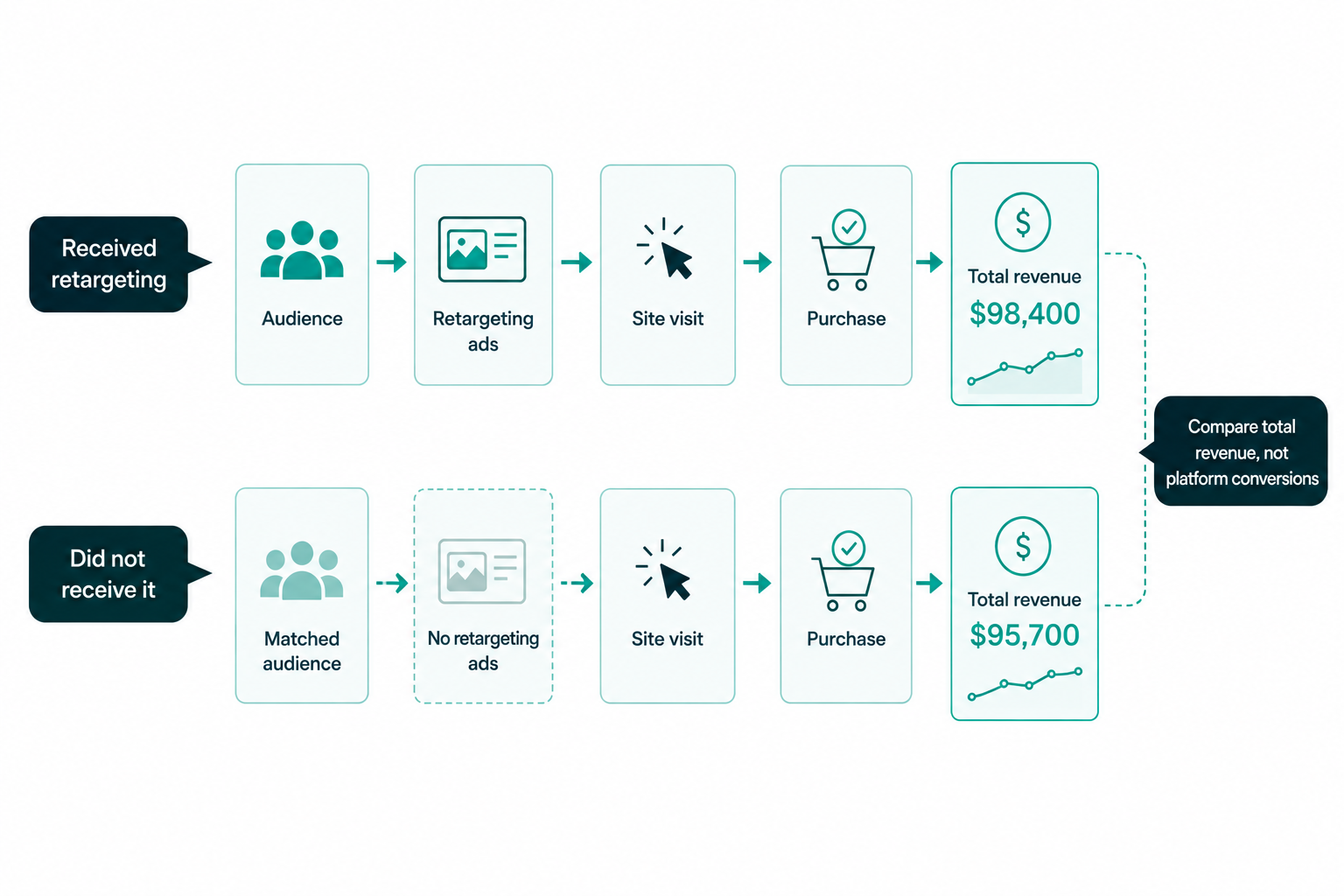
A retargeting test should measure total business outcome rather than platform conversions alone. The goal is to compare what happens when retargeting is present against what happens when it is reduced, paused or held out for a comparable group.
The cleanest structure depends on the business. For some teams, a geographic holdout is practical. For others, an audience holdout may be easier. In both cases, the test should look at total revenue, gross profit, orders, new customers, CAC and the movement of other channels. If retargeting is paused and brand search, direct or organic absorbs most of the demand, that is evidence that retargeting was claiming sales the business would still have captured.
The test also needs to protect against leakage. If the control group still receives retargeting through another campaign, another platform, an affiliate partner or a bundled automated campaign, the read becomes weak. The audience has to be clean enough for the comparison to mean something.
How To Read The Result
The useful output is not a yes-or-no verdict on retargeting. The useful output is the size of the budget tranche that still creates incremental value.
Retargeting can still make sense in specific jobs. It may help recover abandoned baskets, remind buyers during a short consideration window, support offer communication, or serve as a defensive layer in a competitive category. The problem appears when the campaign is allowed to scale far beyond the point where the next dollar creates much new demand.
This is where average ROAS becomes dangerous. The early part of the budget may be incremental enough. The last part may mostly chase the same buyers again. The blended number hides the weak marginal return.
A good read separates those layers. Keep the part that still creates lift. Cut or cap the part that mainly harvests demand. Move the freed budget into demand creation, traffic quality work, brand building, mid-funnel experiments or a stronger incrementality test.
Signs Retargeting Is In The Death Zone
Retargeting is likely in trouble when spend keeps rising but total revenue does not move with it. It is also worth investigating when the campaign has high reported ROAS, high frequency, a very small audience pool, heavy overlap with brand search, and weak movement in new customers or gross profit.
Another warning sign is when finance sees margin pressure while marketing still sees strong campaign ROAS. Both teams may be reading their systems correctly. Marketing sees attributed conversions. Finance sees the business paying more to close demand that already existed.
This is a measurement-frame problem. The campaign is being judged by the question it can answer, not by the question the business needs answered.
The Budget Decision
The decision is usually not to remove retargeting entirely. The decision is to resize it to its incremental role.
Start by identifying the audience and spend layers most likely to be non-incremental: very recent site visitors, cart abandoners who also receive email, existing customers, brand search overlap, affiliate overlap, and automated campaigns that quietly include retargeting-like inventory. Then test the reduction in a way the business can tolerate.
If revenue barely moves after a controlled reduction, that spend was not growth capital. It was a tax on existing demand. The next move is to redeploy it in layers, because large shifts can create volatility before the new work has time to compound.
The strongest retargeting program is sized to the incremental job it actually performs, even if that makes reported ROAS less spectacular.
Related reading
Incremental ROAS vs Attributed ROAS: How to Find Wasted Marketing Spend: Separate credit from contribution before judging a channel.
The Performance Marketing Death Zone: When More Spend Stops Creating Growth: Understand why the last tranche of spend can stop producing growth.
Should You Bid on Your Own Brand? How to Measure Brand Search Incrementality: Apply the same counterfactual logic to another bottom-funnel capture channel.
How to Measure Marketing Incrementality: A Practical Guide for CMOs: Choose the right test design before acting on a high-ROAS channel.
