
Performance Max Incrementality: Is the Algorithm Creating Growth or Harvesting Demand?
Performance Max incrementality is the question behind the platform dashboard: is the algorithm creating new growth, or is it collecting credit from demand that already existed?
Automated campaigns can be very good at finding people who are likely to convert soon. That is useful when the business wants efficient demand capture. The problem appears when the campaign is treated as proof of growth simply because attributed conversions look strong.
For Performance Max, the attribution vs contribution question is direct: did the system create additional gross profit, or did it find conversions the business was already close to capturing?
Algorithms are instruction followers. They optimise toward the objective they are given, inside the data they can see. They do not understand margin, future demand, brand preference, offline sales, sales conversations, competitor context or the true cost of cannibalising other channels unless the system is designed to measure those outcomes.
That creates a simple risk. The algorithm can optimise the platform objective while the business gets weaker incremental growth.
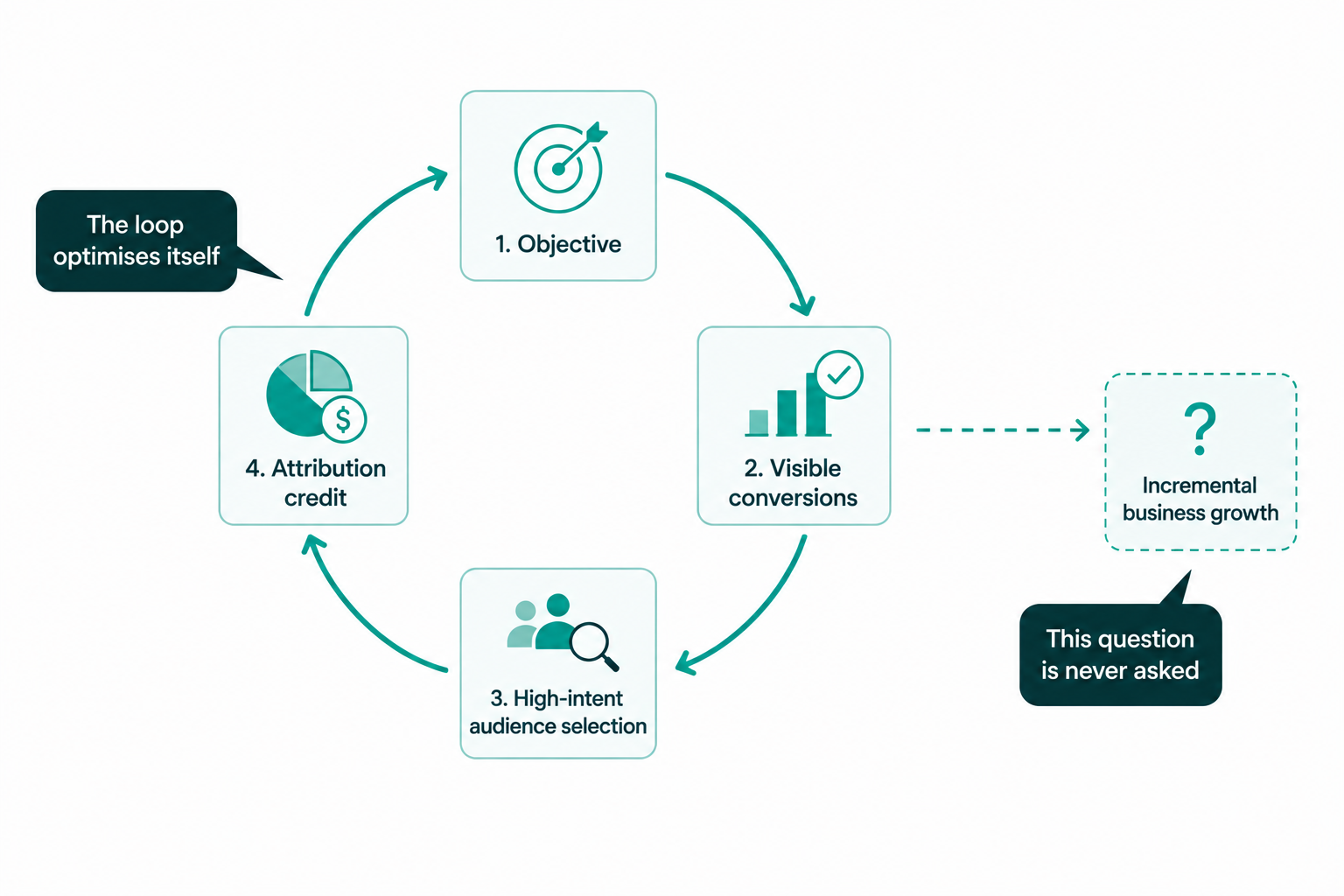
Optimization Is Not The Same As Growth
If a campaign is told to maximise conversions, it will search for the easiest path to conversions. Often that means high-intent users: people already searching, returning, comparing, or close to purchase.
That can improve reported efficiency. It can also concentrate spend near the bottom of the funnel. The campaign becomes excellent at finding people who were already likely to buy, while doing less to create the next pool of buyers.
This is the difference between optimisation and growth. Optimisation improves the metric inside the campaign. Growth increases the business outcome that would not have happened otherwise.
A Performance Max campaign can produce attributed revenue without creating the same amount of incremental revenue. The only way to know is to inspect what it is harvesting and test what changes when spend is reduced, constrained or reallocated.
The Visibility Problem
Automated systems optimise against what they can observe. That is a major limitation in categories with long consideration journeys, offline sales, sales-assisted buying, multiple devices, household decision-making or a large role for brand.
If the platform sees clicks and online conversions but misses store purchases, sales notes, product research, peer recommendations or delayed decisions, it will optimise toward the visible part of the journey. The visible part is often the lower-funnel behaviour.
That does not make the algorithm broken. It means the business has to understand the measurement boundary. A system cannot optimise toward a value signal it cannot see.
This matters for high-ticket B2C and long-cycle B2B. A campaign that creates early consideration may not get credit quickly. A campaign that catches late demand may get credit immediately. If the platform is rewarded for immediate conversions, budget can drift toward capture even when the business needs more demand creation.
Where Cannibalisation Shows Up
The first place to look is channel overlap. If an automated campaign is allowed to cover high-intent inventory, brand-adjacent demand, remarketing-like audiences or product queries already supported by other channels, it may pull conversions away from brand search, organic, direct, shopping, email, affiliates or existing retargeting.
The dashboard may frame this as success. Total platform conversions rise. The campaign looks efficient. Other channels appear weaker. The business may then move more budget into the automated campaign, even if total revenue or gross profit barely changes.
Cannibalisation often looks like a win at campaign level and a wash at business level.
The right read is not whether the automated campaign produced conversions. The right read is whether total outcomes improved after accounting for what other channels lost and what buyers would have done anyway.
What To Audit Before You Test
Start with the objective. Is the campaign optimising for the outcome the business actually values, or a proxy that is easier for the platform to produce? Clicks, leads, trials, add-to-carts and purchases each create different incentives.
Then inspect the conversion quality. For B2B, compare lead volume with sales-qualified leads, pipeline, close rate and gross profit. For B2C, compare purchases with new-customer gross profit, product mix, return rate, repeat purchase and margin. If volume rises while quality deteriorates, the algorithm may be finding the easiest version of the goal.
Next, inspect overlap. Look for movement in brand search, direct, organic, shopping, affiliates, email and retargeting when the automated campaign scales. If the new campaign grows while other capture channels fall, the incremental question becomes urgent.
Finally, inspect traffic quality and product interest. Cheap traffic, strange geography, weak engagement, poor product-page behaviour or bot-heavy placements can make the campaign look active while adding little commercial value.
How To Test Performance Max Incrementality
The test should change what the business controls and read the outcome at business level.
A geographic holdout can work when spend can be varied by market and there is enough stable market-level data. A structured budget reduction can work when the suspected issue is lower-funnel cannibalisation. A split by campaign role can help separate demand capture from demand creation when the account structure allows it.
The read should include total revenue, gross profit, new customers, CAC, product mix and the movement of adjacent channels. If the automated campaign is reduced and total business outcome barely moves, while other channels absorb the conversions, the campaign was likely over-credited.
If total outcome falls meaningfully, the campaign has a stronger incremental role. The next decision is still about scale. The campaign may work at one budget level and become less incremental as it expands.
Use Constraints As A Business Tool
The solution is not to reject automation. The solution is to make sure automation is pointed at the right job.
Some campaigns should capture demand efficiently. Some should create demand. Some should protect margin. Some should grow new customers. One campaign cannot optimise all of those objectives equally well at the same time.
Where controls exist, use them to separate jobs. Keep high-intent capture from prospecting where possible. Separate new-customer growth from existing-customer harvesting where possible. Watch downstream quality, not just conversion volume. Pair automation with an independent incrementality read.
The more opaque the campaign, the more important the external measurement becomes.
The Budget Decision
Performance Max should not be judged only by whether it has a strong ROAS. That asks whether the platform can attribute conversions to the campaign. The budget question is whether the campaign created additional gross profit that the business would not otherwise have captured.
If the answer is yes, scale with a marginal-return view. If the answer is weak, cap it, constrain it, or move the excess budget into demand creation, better traffic quality, stronger creative or a cleaner test.
The algorithm will chase the target it is given. The CMO's job is to make sure the target leads to business growth, with platform reporting treated as a supporting read.
Related reading
The Performance Marketing Death Zone: When More Spend Stops Creating Growth: See how optimisation can become saturation.
Retargeting Incrementality: How Much of Your Retargeting Budget Is Actually Creating Sales?: Understand the same issue in a clearer lower-funnel tactic.
How to Measure Marketing Incrementality: A Practical Guide for CMOs: Choose the right causal test for automated campaign spend.
How to Audit Paid Media Spend for Waste Before You Cut the Channel: Audit traffic, overlap and outcome quality before reallocating budget.
